


+86-13826948503 (Bella)
+86-18145725878 (Carven)

Author: Site Editor Publish Time: 2025-11-18 Origin: Site

In today’s technology-driven industries, cable assemblies are fundamental components that enable reliable power delivery, efficient signal transmission, and safe interconnection between electronic systems. Whether in electronics manufacturing, automotive applications, industrial automation, or telecommunications, the performance and reliability of cable assemblies directly impact the overall functionality of the system. A well-engineered cable assembly ensures optimal conductivity, maintains signal integrity, and provides robust mechanical and environmental protection.
Cable assemblies are not merely bundles of wires; they are highly engineered interconnection systems incorporating conductors, connectors, insulation jackets, shielding, and sometimes overmolding. Their design and quality dictate how well the connected devices operate under stress, vibration, temperature extremes, or electromagnetic interference.
Selecting an unsuitable cable assembly factory can create multiple challenges and costs for businesses:
Poor Quality: Substandard materials or inconsistent assembly practices may result in signal loss, shorts, or electrical failures.
Production Delays: Factories without advanced capabilities or proper planning can cause missed deadlines, affecting downstream operations.
High Maintenance Costs: Low-quality cable assemblies are more prone to failure, requiring frequent repairs or replacements.
System Failures: In critical applications like automotive safety systems, industrial automation, or medical devices, cable failures can compromise safety and result in legal and financial liabilities.
These risks underline the necessity of partnering with an experienced and technically capable factory that follows strict quality standards.
Choosing the right cable assembly factory begins with a comprehensive evaluation of their technical expertise. A capable manufacturer must not only have advanced equipment but also skilled personnel, engineering support, and robust quality management systems to ensure that every cable assembly meets strict performance standards. The factory’s technical capabilities directly influence product reliability, signal integrity, and mechanical durability.
A professional cable assembly factory should possess proficiency in all the essential manufacturing processes required for modern cable assemblies. These processes include:
Cutting and Stripping: Precision cutting is fundamental to ensuring that cables are cut to the exact lengths specified in the design schematics. Accurate cutting prevents slack, tension, or misalignment, which could compromise performance. Proper stripping of insulation at the conductor ends prepares wires for secure and reliable connections. Stripping must be done carefully to avoid damaging wire strands, which could lead to poor crimping or soldering results. Automated cutting and stripping machines are especially valuable in high-volume production for achieving consistent quality and efficiency.
Crimping and Soldering: Crimping provides a mechanical and electrical connection between the conductor and terminal. High-quality crimping ensures low electrical resistance, strong mechanical retention, and long-term reliability under vibration or stress. Soldering is used for permanent connections where durability and signal integrity are critical. Temperature-controlled soldering stations prevent cold joints and thermal damage, ensuring the integrity of both conductors and insulation.
Molding and Overmolding: Overmolding adds a protective layer around connectors or wire junctions, enhancing mechanical strength, reducing strain on conductors, and preventing exposure to moisture or contaminants. Molded components provide additional durability and environmental resistance, which is particularly important for industrial, automotive, and outdoor applications.
Shielding: Cable assemblies that handle sensitive signals or operate in electromagnetically noisy environments require proper shielding to prevent interference. Factories should be capable of applying braided copper, aluminum foil, or composite shields, ensuring that signal integrity is maintained even in high-EMI conditions.
The presence of advanced manufacturing equipment—such as automated cutters, stripping machines, crimpers, soldering stations, overmolding machines, and shielding applicators—is a strong indicator that the factory can maintain high throughput, consistent quality, and repeatable results for complex cable assemblies.
Top-tier cable assembly factories offer more than just manufacturing; they provide engineering expertise that can significantly improve design efficiency and product reliability:
Schematic Review: Experienced engineers review client-provided drawings to confirm feasibility, compliance with electrical and mechanical standards, and adherence to client requirements. This step helps prevent design errors before production begins, saving time and cost.
Prototyping: Creating prototypes allows engineers to validate the design under real-world conditions. This includes testing electrical continuity, signal integrity, mechanical robustness, and environmental resistance. Prototyping is especially valuable for complex assemblies, high-speed data cables, or applications where reliability is critical.
Custom Solutions: Factories with strong engineering support can develop tailored solutions for specific projects. Examples include high-speed LVDS assemblies, automotive wiring harnesses, medical device cables, and industrial robotics interconnects. Custom engineering ensures that the final cable assembly meets all functional, mechanical, and environmental requirements.
A reliable factory maintains a rigorous quality assurance system with comprehensive testing procedures to guarantee the performance of every cable assembly:
Electrical Testing: This includes continuity checks, insulation resistance measurements, and high-voltage or high-current tests to detect potential shorts, open circuits, or excessive resistance. Such testing ensures the assembly performs reliably in electrical and signal applications.
Mechanical Testing: Bend, pull, and insertion tests simulate operational stress to confirm that connectors remain secure, conductors maintain integrity, and assemblies resist mechanical fatigue. These tests are particularly important for automotive, industrial, and high-vibration applications.
Environmental Testing: Thermal cycling, humidity exposure, and vibration tests replicate challenging operating conditions, verifying long-term durability and stability.
Through advanced testing and QA protocols, a capable factory ensures that each cable assembly not only meets design specifications but also performs reliably in the field over its intended lifecycle.
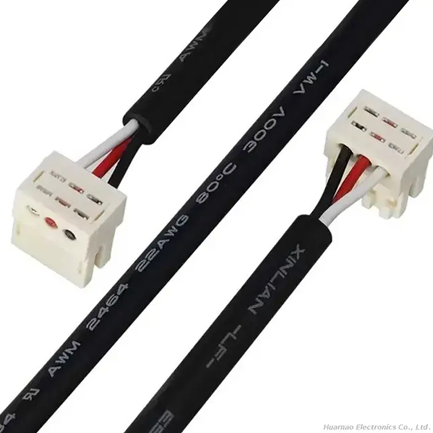
High-quality materials are the foundation of durable, reliable cable assemblies. A factory’s ability to source premium components directly impacts performance, longevity, and environmental resilience.
Conductors are the backbone of any cable assembly, responsible for carrying power and signals efficiently. Key factors to consider include:
Material: High-purity copper is commonly used due to its excellent conductivity. Tinned copper or specialized alloys may be employed for improved corrosion resistance, thermal stability, or specific electrical characteristics.
Wire Gauge: The correct gauge ensures that the cable can safely carry the required current without excessive heating or voltage drop, which is crucial for both power and signal integrity.
Stranding Patterns: Stranded wires offer flexibility and fatigue resistance for dynamic applications such as robotic arms or automotive harnesses, while solid conductors provide rigidity for fixed installations.
For multi-core cable assemblies, proper conductor selection allows simultaneous transmission of power and signals, helping reduce clutter, improve organization, and maintain electrical performance.
Connectors are the interface between a cable assembly and the devices it serves. High-quality connectors are essential for long-term reliability and performance:
Molded Connectors: These provide ruggedness, environmental protection, and strain relief.
IDC (Insulation Displacement Connectors): Allow fast, reliable, and consistent connections without stripping the insulation, ideal for high-density or repetitive wiring tasks.
LVDS Connectors: Preserve signal integrity in high-speed data applications, ensuring minimal crosstalk and signal loss.
Custom Connectors: Tailored to unique applications for precise fit, mechanical retention, and optimal electrical performance.
Compatibility with leading connector brands such as TE, Molex, JST, Amphenol, Hirose, and Yazaki indicates a factory’s ability to handle global standards and maintain quality assurance.
Insulation and protective jackets safeguard conductors from mechanical damage, chemical exposure, and environmental stress. Common materials include:
PVC: Affordable, flexible, and suitable for general-purpose applications.
PTFE (Teflon): Offers excellent thermal, chemical, and abrasion resistance, ideal for harsh industrial and automotive environments.
PU and TPE: Provide high flexibility, durability, and resistance to repeated bending, making them suitable for dynamic or outdoor applications.
Selecting the right combination of insulation and jacket materials ensures that assemblies remain reliable under mechanical stress, vibration, and environmental extremes.
For assemblies that carry sensitive or high-speed signals, shielding is essential to prevent electromagnetic interference (EMI) and maintain signal integrity. Options include:
Braided Copper: Offers robust EMI protection and mechanical strength.
Aluminum Foil: Lightweight, flexible, and effective for high-frequency interference.
Composite Materials: Combine multiple shielding strategies to meet specialized requirements for critical applications.
Proper material selection—from conductors to insulation, connectors, and shielding—is fundamental to producing cable assemblies that deliver reliable electrical performance, mechanical durability, and long-term operational stability in diverse industries, including automotive, telecommunications, industrial automation, and consumer electronics.
Industry expertise is critical when choosing a cable assembly factory, as different applications impose distinct mechanical, electrical, and environmental demands.
Automotive assemblies must withstand:
Vibration from engines and road conditions
Extreme temperature variations
Exposure to oils, fuels, and chemicals
Experienced factories understand automotive standards and produce harnesses that maintain performance under harsh conditions.
Industrial assemblies often require:
High-speed signal transmission
Robust power distribution
Flexibility for robotic arms or moving equipment
Factories with automation experience can provide cable assemblies that endure mechanical stress while maintaining signal integrity.
Telecom and networking applications demand:
High-density LVDS or IDC assemblies
Minimal signal loss over long distances
EMI protection for stable data transmission
Experienced factories ensure assemblies meet stringent communication standards.
Cable assemblies in these fields must comply with safety and performance regulations, including:
Low electromagnetic emissions
Biocompatibility (for medical applications)
Precision and reliability in small-form-factor assemblies
A factory with diverse application experience can adapt to specific regulatory and performance requirements.
A quality cable assembly factory should offer flexibility in design and production.
Custom Wire Lengths and Connector Types: Tailored to fit specific equipment or installation requirements.
Shielding and Overmolding Options: Adjustable based on environmental exposure and signal sensitivity.
Small-Batch or Prototype Support: Useful for R&D, pilot runs, or specialized projects.
Engineering Collaboration: Ability to scale prototypes to full production with consistency and quality assurance.
Flexibility ensures that clients receive cable assemblies designed precisely for their applications, reducing installation issues and enhancing long-term reliability.
Certifications and in-house quality controls indicate a factory’s commitment to excellence. Key indicators include:
ISO 9001: General quality management system compliance
ISO 13485: Quality standards for medical devices
UL and CE: Safety and regulatory compliance
FCC: Electromagnetic compatibility for electronic products
IPC/WHMA-A-620: Wire harness and cable assembly manufacturing standard
Professional factories maintain labs to perform:
Tensile and Bend Tests: Ensures mechanical durability
Insertion Tests: Confirms secure connector seating
Thermal and Environmental Tests: Verifies performance under temperature extremes
2D and Dimensional Measurement: Confirms assembly matches design specifications
Factories should conduct 100% testing of finished assemblies, including:
Electrical continuity and insulation checks
Signal integrity verification
Visual inspection and mechanical validation
These processes minimize field failures and ensure that every assembly meets or exceeds client expectations.
Choosing the right cable assembly factory is a critical step that directly affects system reliability, operational efficiency, and long-term cost management. By carefully evaluating technical expertise, material sourcing, industry experience, customization capabilities, and quality management, engineers and procurement teams can select a factory that consistently delivers high-quality, durable, and reliable cable assemblies.
Professional manufacturers like Huamao Cable provide comprehensive solutions, from custom LVDS and IDC assemblies to automotive wiring harnesses and industrial-grade cable assemblies. With strict adherence to ISO, IPC, and international standards, robust in-house testing, and flexible production capabilities, such factories ensure that every cable assembly meets the exact requirements of modern electronic and industrial applications.
1. What should I look for in a cable assembly factory?
Check the factory’s technical skills, equipment, engineering support, and certifications to ensure consistent quality and reliability.
2. Why are ISO and IPC certifications important?
They prove the factory follows international standards for quality control and production consistency.
3. Can I order custom cable assemblies?
Yes. A good factory offers custom lengths, connectors, overmolding, and shielding, plus engineering support for prototypes.
4. What materials make a good cable assembly?
Use pure copper conductors, quality connectors (like Molex or JST), and durable insulation such as PVC or TPE with proper shielding.
5. How does Huamao Cable ensure quality?
Huamao Cable follows ISO standards, conducts 100% testing, and uses advanced in-house labs to guarantee high performance.
