


+86-13826948503 (Bella)
+86-18145725878 (Carven)

Author: Site Editor Publish Time: 2026-05-29 Origin: Site

Can you afford a signal failure caused by a simple measurement error? An idc cable assembly maximizes efficiency by creating gas-tight seals without stripping any wires. However, selecting the wrong pitch often leads to instability. This guide provides a technical framework to master the critical pitch selection process.
● Manufacturing Efficiency: An idc cable assembly significantly reduces labor costs by terminating multiple conductors simultaneously without the need for wire stripping.
● Pitch Selection is Critical: Choosing between 2.54mm, 2.0mm, or 1.27mm pitches determines the assembly's current capacity, voltage rating, and mechanical footprint.
● The Half-Pitch Rule: For optimal alignment, ensure the ribbon cable pitch is typically half the size of the connector pitch (e.g., a 0.635mm cable for a 1.27mm connector).
● Application-Specific Use: IDC technology is best suited for internal point-to-point wiring and daisy-chaining in stable environments like industrial control cabinets and medical devices.
● Material Compatibility: Reliable connections depend on using stranded wire and matching the plating (Gold vs. Tin) to the mating header to prevent corrosion.
● Quality Assurance: Always utilize strain relief clips and perform continuity testing to ensure the integrity of the gas-tight seal against mechanical stress.
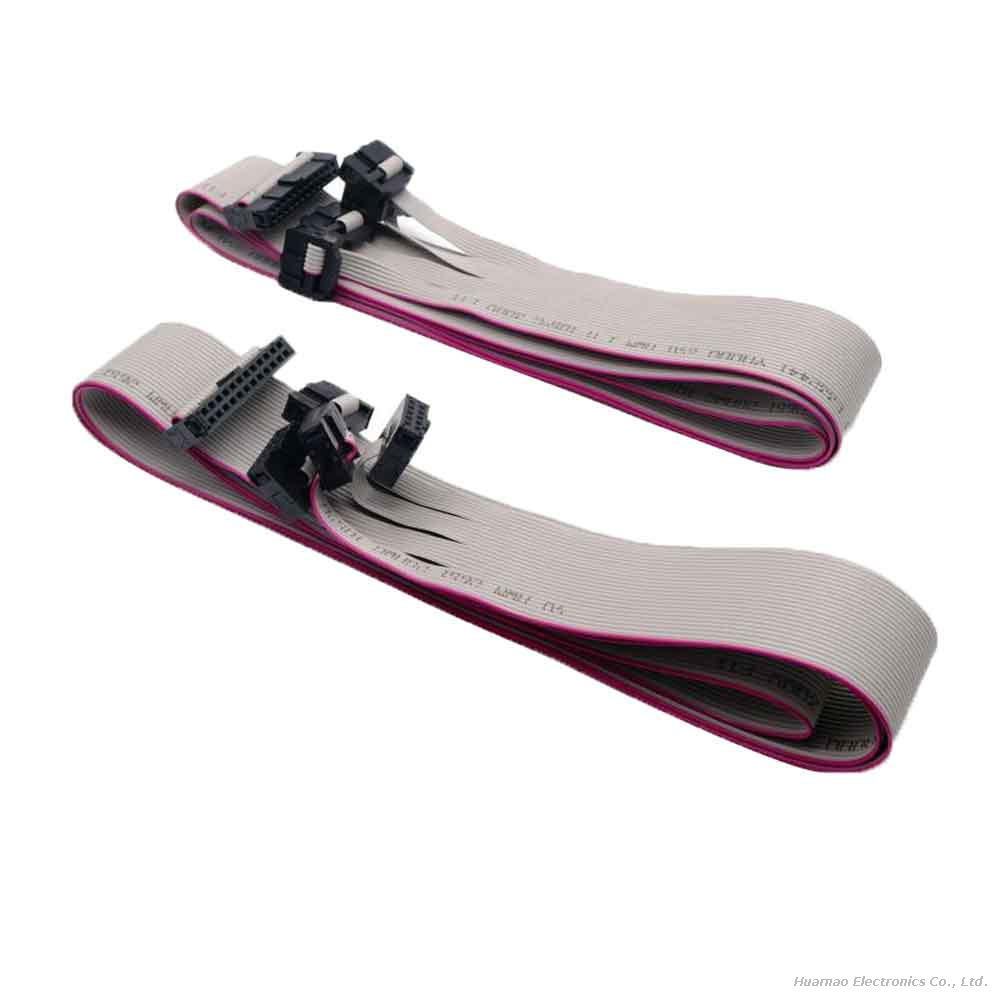
Selecting the correct pitch is the most influential decision in designing an idc cable assembly. It dictates the physical footprint, the type of ribbon cable required, and the ultimate reliability of the connection.
The "pitch" refers to the distance between the center of one conductor and the center of the next. Industry standards have shifted toward miniaturization, but legacy sizes remain vital for durability.
● 2.54mm (0.100") Pitch: This is the traditional standard. It offers maximum mechanical strength and is widely used in industrial motherboards and rugged machinery where space is less critical than robustness.
● 2.0mm Pitch: A popular "middle ground" for modern industrial electronics. It provides a significant space saving over the 2.54mm version while maintaining enough physical integrity for frequent manual handling.
● 1.27mm (0.050") and Below: Essential for high-density computing and medical devices. These fine-pitch assemblies require specialized automated equipment for precise alignment.
As pitch decreases, so does the physical space for copper and insulation. This creates several electrical trade-offs:
Feature | 2.54mm Pitch | 1.27mm Pitch | Impact on Design |
Typical Wire Gauge | 26 - 28 AWG | 28 - 30 AWG | Smaller pitch limits current capacity. |
Current Rating | ~3.0A | ~1.0A | Heat dissipation is harder in tight spaces. |
Voltage Rating | High (250V+) | Low (30V - 125V) | Risks of arcing/creepage increase as pitch shrinks. |
Tighter spacing also increases the risk of crosstalk. In high-speed data applications, engineers often use "ground-signal-ground" wiring patterns within the ribbon cable to mitigate interference.
A common point of confusion is the "Half-Pitch Rule." For a standard idc cable assembly, the ribbon cable pitch is usually half that of the connector pitch. For example, a 1.27mm connector typically uses a 0.635mm pitch cable. This allows the connector contacts to stagger across the wires, ensuring a secure bite without overstressing the plastic housing.
Note: Always verify that your chosen ribbon cable's tolerance matches the connector manufacturer’s specifications to prevent "cumulative pitch error" on high-pin-count assemblies.
Tip: For applications prone to heavy movement, always specify a connector with integrated strain relief latches to prevent the ribbon cable from backing out of the IDC tines.
Engineers often debate whether to use an idc cable assembly or traditional crimp-and-poke connectors. The choice usually hinges on volume and the specific wiring architecture.
IDC technology is the undisputed leader in manufacturing efficiency. Unlike crimping, which requires stripping and terminating each wire individually, an IDC press terminates all conductors simultaneously. In a 50-pin assembly, this reduces termination time by over 90%.
IDC is ideal for internal "static" connections. If you need to link a PCB to a front-panel LCD or an internal sensor array, a ribbon cable provides a neat, flat profile that improves airflow and simplifies cable management within the enclosure.
One unique advantage of the idc cable assembly is the ability to "bus" signals. You can press multiple connectors onto a single length of ribbon cable without cutting it. This is highly effective for LED arrays or multi-drive storage systems where the same signal must reach several nodes.
While the specialized tooling (presses and dies) represents an initial investment, the reduction in labor hours usually yields a lower "total cost per connection" in mid-to-high volume runs.
Tip: Use IDC for prototype stages to speed up assembly, but ensure the final production environment doesn't subject the cables to constant sharp-angle flexing.
Different industries leverage the idc cable assembly for its unique blend of speed and reliability.
In control cabinets, space is a premium. IDC connectors provide reliable, vibration-resistant links for low-power signals. The gas-tight connection prevents oxidation in the harsh, oily environments common in factory floors.
From internal hard drive connections to laptop display hinges, IDC allows for incredibly thin form factors. High-density 0.635mm assemblies are standard for internal data busing where high signal counts must fit into razor-thin housings.
Medical devices often require lightweight, flexible signal routing. Fine-pitch IDC solutions are frequently found in imaging devices and patient monitors because they offer high-density connectivity without adding significant weight or bulk.
Reliability is non-negotiable in server racks. IDC is used in distribution frames and patch panels because it provides a permanent, low-resistance connection that can survive years of static operation without maintenance.
Note: In medical applications, ensure the ribbon cable insulation meets biocompatibility or flame-retardancy standards like UL94V-0.
Despite its benefits, an idc cable assembly is not a universal solution. Understanding its limitations prevents field failures.
IDC is highly sensitive to wire construction. It works best with stranded wire, which deforms slightly to create a larger contact surface area. Solid wire can be used but carries a risk of "shearing" if the IDC tines are too sharp. Furthermore, the insulation hardness must be compatible; if the plastic is too tough, the tines may bend before reaching the copper.
Because most IDC connectors are "open," they are susceptible to moisture. In corrosive environments, the contact points can degrade if not protected by a secondary enclosure. Additionally, IDC is not designed for high-power applications. Attempting to run high current through a fine-pitch idc cable assembly will cause localized heating and eventual melting of the connector housing.
Successful integration requires looking at the materials and tooling that support the connector.
● PVC: The standard for general use; cost-effective and flexible.
● TPE: Better for moderate flexing applications.
● Teflon (FEP): Required for extreme temperature environments or where chemical resistance is necessary.
To prevent galvanic corrosion, always match the plating of the idc cable assembly to the mating header on the PCB.
● Gold Plating: Best for low-voltage, high-reliability signals and high-cycle counts.
● Tin Plating: Sufficient for static, cost-sensitive connections, but prone to "fretting" if vibration is present.
Tooling Type | Production Volume | Key Benefit |
Manual Hand Press | Low / Prototyping | Portable and inexpensive. |
Bench Press | Medium | Consistent pressure and alignment. |
Fully Automated | High | Maximum speed and integrated testing. |
Quality control is paramount because a single bad "bite" can ruin a 50-conductor cable.
Technicians should look for:
1. Alignment: Are the tines hitting the center of the conductors?
2. Depth: Is the connector fully "clicked" into place?
3. Insulation Integrity: Is the ribbon cable crushed or torn at the entry point?
Every idc cable assembly should undergo continuity testing to check for shorts or opens. For critical medical or aerospace applications, "Hi-Pot" (High Potential) testing is used to ensure the insulation can handle voltage spikes without breaking down.
The connection is only as good as its physical security. Using strain relief clips is a best practice. These plastic clips wrap over the cable and snap into the connector, ensuring that any tension on the cable is absorbed by the connector body rather than the delicate IDC contacts.
Note: Automated IDC machines often include "pull-force" sensors to verify that the termination meets IPC-A-620 standards.
Selecting the right idc cable assembly requires balancing pitch, wire gauge, and the environment. While 2.54mm remains a rugged standard, fine-pitch 1.27mm options enable modern miniaturization. At wiringharnesscn, we provide high-quality interconnect solutions designed for maximum reliability and precision. Following these technical frameworks ensures your systems remain cost-effective and future-proof. Our specialized team helps you validate the perfect trinity of connectors, cables, and professional tooling.
A: An idc cable assembly offers massive labor savings by terminating all conductors simultaneously without stripping wires.
A: Balance your space constraints with current needs; use 2.54mm for ruggedness or 1.27mm for high-density miniaturization.
A: Choose an idc cable assembly for high-volume production speed and efficient daisy-chaining across multiple PCB headers.
A: Yes, provided you use strain relief clips and ensure a gas-tight fit during the idc cable assembly termination.
