


+86-13826948503 (Bella)
+86-18145725878 (Carven)


A wiring job becomes much easier when the connection between two cables is fast to make, secure in use, and simple to disconnect later. That is why a electrical wire connector is used in so many real products. Instead of serving as a basic join between two loose wires, it helps create a cleaner cable system that is easier to assemble, maintain, and repair. In appliance wiring, industrial harnesses, battery links, and many serviceable devices, this kind of connector supports both practical installation and long-term reliability. As a supplier of wire harnesses, cables, and connector products, Huamao Cable provides wire-to-wire solutions designed for direct cable connection in a wide range of electrical applications.
A wire-to-wire connector connects one cable end directly to another cable end without using a PCB as the interface. This is the core idea behind the product. While many connectors are designed to bring wires onto a board, a wire-to-wire format is meant for situations where two cable sections need to meet directly. That makes it useful in systems that depend on modular wiring, harness branching, extension leads, or field-replaceable cable sections.
This direct cable connection is valuable because it gives the system more flexibility. Instead of treating the entire wiring path as one fixed assembly, manufacturers can divide it into sections that are easier to install and easier to manage. One part of the harness can be assembled first, another part can be added later, and both can be connected only when needed. In real production, that often means less confusion, better routing, and more efficient assembly.
Detachable wiring changes the way a product is built and serviced. If a connection can be unplugged rather than cut apart, both installation and maintenance become more practical. A technician can remove one cable section without disturbing the rest of the harness. A damaged part can be replaced faster. An upgrade can be completed without rebuilding the whole connection path.
This matters in real products because service time costs money. The easier it is to separate one wiring section from another, the easier it is to inspect faults, replace worn parts, and keep equipment in operation. A wire-to-wire connector does more than complete an electrical path. It helps shape the system into something more modular and more manageable over the full life of the product.
Appliances and lighting systems are two of the most common environments where wire-to-wire connections make an immediate difference. These products often need fast cable joining, organized routing, and easier replacement during service. In a lighting application, the benefit may be faster branch connection and less installation time. In an appliance, it may be cleaner internal wiring and easier replacement of one assembly section during repair.
In both cases, the connector supports efficiency. Assemblers can work faster because the cable sections are easier to join. Service teams can work faster because the wiring is more accessible. The final product also tends to look more organized because the cable system is structured rather than improvised. For products built in volume, those improvements can make a noticeable difference in labor and service performance.
In automotive and industrial systems, wire-to-wire connectors often need to perform under more demanding conditions. Wiring harnesses in these products may face movement, vibration, repeated handling, and more complex assembly paths. A direct cable connection is still useful, but it has to remain secure over time.
This is why wire-to-wire designs are so widely used in harness-based equipment. They allow different harness sections to be built separately and then mated during final assembly. That supports more efficient production, especially in larger or more complex systems. At the same time, a well-designed connector helps ensure that the cable connection remains stable during operation. In environments where maintenance access matters and harness routing can become complicated, an inline connector is often a practical solution.
One of the biggest advantages of wire-to-wire design appears after the product is already in use. A modular cable system is easier to inspect and easier to maintain. Instead of dealing with one continuous wiring assembly, technicians can focus on one section at a time. This simplifies diagnostics and helps reduce downtime.
That benefit is especially clear in control equipment, serviceable devices, field-installed systems, and products with a long operating life. The same connector that helps first-time assembly also helps later replacement. If one section of the system fails, the cable path does not need to be rebuilt from scratch. In this way, a wire-to-wire connector adds long-term value beyond the original installation.
Application | Why use a wire-to-wire connector | Feature that matters most |
Lighting wiring | Faster branch connections | Quick installation |
Industrial equipment | Stable mating under vibration | Locking mechanism |
Serviceable devices | Easier replacement | Detachable structure |
Battery and charger link | Reliable power transfer | High-current contact design |
A detachable connector must still stay firmly connected during actual use. That is why locking mechanisms are an important part of many wire-to-wire products. A proper locking feature helps prevent accidental separation caused by vibration, transport, movement, or repeated handling.
This matters because an unsecured cable connection can create intermittent faults, service problems, or unexpected downtime. By adding retention and controlled mating, the connector becomes more dependable as a system component. In industrial equipment, automotive harnesses, and portable electrical products, this kind of security is often a basic requirement rather than an optional feature.
Mechanical stress can damage a cable connection even when the electrical design is correct. Pulling force, bending, or repeated cable movement can transfer stress directly into the contact area if the connector is not properly supported. That is why strain relief and vibration resistance are so important.
Good connector design helps protect the electrical path from mechanical disturbance. Instead of letting every cable movement affect the termination directly, the structure helps manage that force more effectively. This can improve durability, reduce wear, and support more stable performance over time. For applications that involve moving equipment or repeated cable handling, this is a very practical advantage.
Not every wire-to-wire connector is made for the same environment. Some are best suited to clean, protected indoor use, such as appliances, indoor controls, or enclosed wiring systems. Others are more appropriate for harsher conditions where moisture, dust, or frequent handling can affect performance.
This is important because connector choice should follow the real operating environment, not just the connection style. A simple unsealed design may be completely suitable for one product and completely unsuitable for another. Understanding the working conditions helps ensure that the final cable connection is not only convenient, but also dependable in daily use.
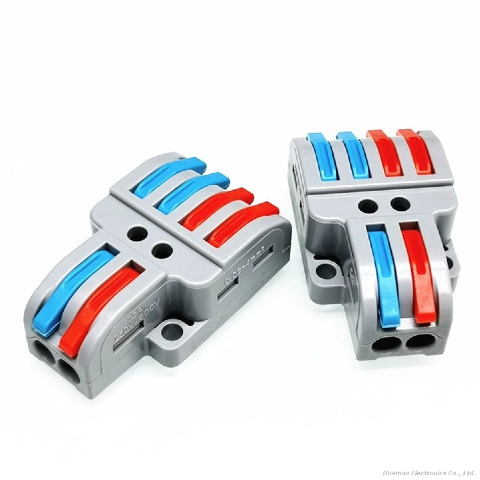
Some wire-to-wire applications are mainly about saving installation time. In lighting, commercial wiring, and control tasks, quick splicing connectors are often more practical than larger plug-and-socket structures. They help reduce labor, simplify field connection, and keep the job moving efficiently.
A good example is the PCT LT-422 quick terminal block from Huamao Cable. This kind of product is well suited to wiring work that requires fast and secure connection with simple handling. It supports installers who need efficiency without sacrificing connection quality. For many routine wiring tasks, that balance of speed and reliability is exactly what the application demands.
Wire-to-wire products are not limited to light-duty signal or branch wiring. Some are designed for much heavier electrical loads. In battery systems, charger links, forklifts, and energy storage equipment, the connector must support repeated use while carrying higher current reliably.
That is where high-current product styles become important. Anderson-style connector solutions from Huamao Cable fit this type of demand well because they are built for stronger power transfer and more robust service conditions. This shows the full range of the wire-to-wire category. Some products are chosen for quick installation, while others are chosen for dependable power delivery.
The first question should always be whether the connector matches the electrical load and the cable size. If either of those is wrong, the connection may not perform as intended. This is the most important starting point because it helps prevent mismatch, rework, and unnecessary trouble later.
The right connector is not defined by current rating alone. Circuit count and mating structure also influence how cleanly and efficiently the final assembly can be completed. A better-matched design supports faster work, easier routing, and more organized wiring.
A connector that installs quickly is valuable, but speed should not come at the expense of long-term performance. The best solution is one that saves time during assembly and still remains practical for inspection, replacement, and continued operation. In real projects, installation convenience and service reliability should support each other.
A wire to wire connector is more than a small joining part in a cable system. It helps make direct cable connections faster to install, easier to service, and more dependable over time, especially when the system does not rely on a PCB connection point. From lighting and appliances to industrial harnesses and power equipment, the right product style can improve both wiring efficiency and maintenance convenience. Huamao Cable offers these solutions as part of its broader wire harness, cable, and connector product range for global customers. If your application needs a secure and practical direct cable connection, contact us to find the right wire to wire connector for your project.
A wire-to-wire connector is used to join two cable ends directly without a PCB. It is common in appliances, harness systems, industrial equipment, lighting wiring, and power connections.
Because it allows the wiring to be disconnected for service, inspection, replacement, or modular assembly. This makes the system easier to maintain and often faster to install.
No. Some are designed for protected indoor environments, while others are built for harsher conditions that involve vibration, moisture, or heavy handling.
Yes. Some wire-to-wire products are designed specifically for high-current power transfer in battery systems, chargers, forklifts, and energy storage equipment.
